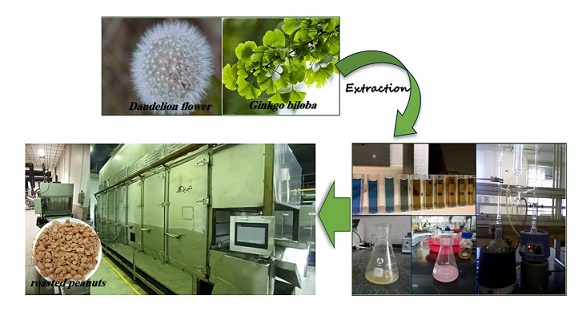
|
1. Mortazavi M. Investigation of aflatoxin levels in pistachio and the effect on physical and chemical characteristics. Journal of Innovation in Food Science and Technology 2012; 6(1). [In Persian]. 2. Zaki N., & Naeem, M. Antioxidant, antimicrobial and anticancer activities of citrus peels to improve the shelf life of yoghurt drink. Egyptian Journal of Food Science 2021; 49(2), 249-265. 3. Radfar, R., & Fatemi, H. Investigation of optimal roasting conditions to prevent oxidation in hazelnut and peanut oils. Iranian Journal of Agricultural Sciences 2013; 34(1). [In Persian]. 4. Razavi, R., Maghsoudlou, Y., Ghorbani, M., & Aalami, M. Investigating the effects of edible carboxymethyl cellulose coating containing thyme hydroalcoholic extract on moisture absorption and fungal growth in fresh hazelnut kernels [Conference paper]. 1st National Conference on Comprehensive Strategic Quality Development in Food Safety. 2014. [in Persian] 5. Yiğit, A., Bielska, P., Cais-Sokolińska, D., & Samur, G. Whey proteins as a functional food: Health effects, functional properties, and applications in food. Journal of the American Nutrition Association, 2023; 42(8), 758-768. [ DOI:10.1080/27697061.2023.2169208] 6. Fatemi, H. (1999). Food Chemistry. Tehran: Sherkat Sahami Enteshar. 7. Liu S, Li S, Ho CT. Dietary bioactives and essential oils of lemon and lime fruits. Food Science and Human Wellness. 2022; 1;11(4):753-64. [ DOI:10.1016/j.fshw.2022.03.001] 8. Tabassum NE, Das R, Lami MS, Chakraborty AJ, Mitra S, Tallei TE, Idroes R, et al. Ginkgo biloba: A treasure of functional phytochemicals with multimedicinal applications. Evidence-Based Complementary and Alternative Medicine 2022;2022:8288818. [ DOI:10.1155/2022/8288818] 9. Diamond BJ, Shiflett SC, Feiwel N, Matheis RJ, Noskin O, Richards JA, et al. Ginkgo biloba extract: mechanisms and clinical indications. 2000;81:668-78. [ DOI:10.1016/S0003-9993(00)90052-2] 10. van Beek TA, Montoro P. Chemical analysis and quality control of Ginkgo biloba leaves, extracts, and phytopharmaceuticals. J J o C A 2009;1216:2002-2032. [ DOI:10.1016/j.chroma.2009.01.013] 11. Pramparo M, Gregory S, Mattea M. Immersion vs percolation in the extraction of oil from oleaginous seeds. A O C S 2002;79:955-960. [ DOI:10.1007/s11746-002-0586-3] 12. Serea C, Barna O, Manley M, Kidd M. Effect of storage temperature on the ascorbic acid content, total phenolic content, and antioxidant activity in lettuce (Lactuca sativa L.). Journal of Animal and Plant Sciences 2014;24:1173-1177. 13. Silva F, Veiga F, Cardoso C, Dias F, Cerqueira F, Medeiros R, Paiva Santos AC. A rapid and simplified DPPH assay for analysis of antioxidant interactions in binary combinations. Microchemical Journal 2024;202:110801. [ DOI:10.1016/j.microc.2024.110801] 14. Association of Official Analytical Chemists (AOAC). Official methods of analysis. 12th ed. Washington, DC: Association of Official Analytical Chemists; 1975. 15. Wang H, Pampati N, McCormick WM, Bhattacharyya L. Protein nitrogen determination by kjeldahl digestion and ion chromatography. J o P S 2016;105:1851-1857. [ DOI:10.1016/j.xphs.2016.03.039] 16. Bandyopadhyay, M., Chakraborty, R., Raychaudhuri, U. J. L.-F. S., & Technology. (2008). Antioxidant activity of natural plant sources in dairy dessert (Sandesh) under thermal treatment. 41(5), 816-825. [ DOI:10.1016/j.lwt.2007.06.001] 17. Carson CF, Mee BJ, Riley TV. Mechanism of action of Melaleuca alternifolia (tea tree) oil on Staphylococcus aureus determined by time-kill, lysis, leakage, and salt tolerance assays and electron microscopy. Antimicrobial agents and chemotherapy 2002;46:1914-1920 [ DOI:10.1128/AAC.46.6.1914-1920.2002] 18. Hammer KA, Carson CF, Riley TV. Antifungal effects of Melaleuca alternifolia (tea tree) oil and its components on Candida albicans, Candida glabrata, and Saccharomyces cerevisiae. Journal of Antimicrobial Chemotherapy 2004;53:1081-1085. [ DOI:10.1093/jac/dkh243] 19. Abbasifar A, Akhondzadeh Basti A, Karim G, Misaghi A, Bokaee S, Gandomi H, Jebeli J A, Hamedi H, Sari AA. Evaluation of Zataria mutiflora Boiss. Effect on Staphylococcus aureus in feta cheese. Journal of Medicinal Plants 2008;7:105-115. [in Persian] 20. Saeedi M, Ebrahimzadeh MA, Morteza-Semnani K, Akha A, Rabiei K. Evaluation of antibacterial effect of ethanolic extract of Foeniculum vulgare Mill. J Mazand Univ Med Sci 2010;20:88-91. [in Persian] 21. Arora DS, Kaur GJ. Antibacterial activity of some Indian medicinal plants. Journal of Natural Medicines 2007;61:313-317. [ DOI:10.1007/s11418-007-0137-8] 22. Singh N, Singh RK, Bhunia AK, Stroshine RL. Efficacy of chlorine dioxide, ozone, and thyme essential oil or a sequential washing in killing Escherichia coli O157: H7 on lettuce and baby carrots. LWT 2002;35:720-729. [ DOI:10.1006/fstl.2002.0933] 23. Dakhili M, Zahraei Salehi T, Torabi Goodarzi M, Khavari A. Evaluation of antimicrobial effects of 4 medicinal plants against Salmonella typhymurium and comparison of them with common antibiotics in veterinary medicine. Journal of Medicinal Plants 2006;5:21-26. 24. Oussalah M, Caillet S, Lacroix M. Mechanism of action of Spanish oregano, Chinese cinnamon, and savory essential oils against cell membranes and walls of Escherichia coli O157:H7 and Listeria monocytogenes. Journal of Food Protection 2006;69:1046-1055. [ DOI:10.4315/0362-028X-69.5.1046] 25. Leistner L, Gorris LGM. Food preservation by hurdle technology. Trends in Food Science & Technology 1995; 6:41-46. [ DOI:10.1016/S0924-2244(00)88941-4] 26. Kargozar A, Mortazavi A, Sharifi A. The effect of dandelion extract on physicochemical and microbial properties of low calorie probiotic yogurt. Arak Medical Sciences 2009;11:230-235. [in Persian] 27. Min DB, Boff JM. Lipid oxidation of edible oil. In: Akoh CC, Min DB, editors. Food lipids: chemistry, nutrition, and biotechnology. 2nd ed. New York: Marcel Dekker; 2002. p. 335-364. [ DOI:10.1201/9780203908815.pt3] 28. Khoshnoudinia S, Sedaghat N. Effect of edible coatings containing antioxidant agents on oxidative stability and sensory properties of roasted pistachio nuts (Ohadi variety). Iranian Journal of Nutrition Sciences & Food Technology 2014;9:11-20. [in Persian] 29. Li J, Li W, Su J, Liu W, Altura BT, Altura BM. Hydrogen peroxide induces apoptosis in cerebral vascular smooth muscle cells: possible relation to neurodegenerative diseases and strokes. J B r b 2003;62:101-106. [ DOI:10.1016/j.brainresbull.2003.08.011] 30. Mellema MJ. Mechanism and reduction of fat uptake in deep-Fat Fried Foods. Trends in Food Science and Technology 2003;14:364-373. [ DOI:10.1016/S0924-2244(03)00050-5] 31. Abdulkarim S, Long K, Lai OM, Muhammad S, Ghazali H. Frying quality and stability of high-oleic Moringa oleifera seed oil in comparison with other vegetable oils. Food Chemistry 2007;105:1382-1389. [ DOI:10.1016/j.foodchem.2007.05.013] 32. Bagheri H, Kashani-Nejad M, Aalami M, Ziaeifar AM. Optimization of hot air roasting conditions for peanut kernels using response surface methodology. Food Science and Nutrition 2019;16:33-44. [in Persian] 33. Mohammad Zade Milani J, Nasrolah Taj L, Kaboosi H, Maleki G. Effect of Charkhak (Launaeaacanthodes) gum coating on shelf life of peanuts. Journal of Food Science and Technology (Iran) 2017;14:83-90.[in Persian] 34. Del Nobile MA, Conte A, Incoronato AL, Panza O. Antimicrobial efficacy and release kinetics of thymol from zein films. Journal of Food Engineering 2008;89:57-63. [ DOI:10.1016/j.jfoodeng.2008.04.004] 35. Amaral JS, Casal S, Seabra RM, Oliveira BP. Effects of roasting on hazelnut lipids. Journal of Agricultural and Food Chemistry 2006;54:1315-1321. [ DOI:10.1021/jf052287v] 36. Buckholz LL, Daun H, Stier E, Trout R. Influence of roasting time on sensory attributes of fresh roasted peanuts. Journal of Food Science 1980;45:547-554. [ DOI:10.1111/j.1365-2621.1980.tb04098.x] 37. Powell J. Evaluation of Initial Flavor Fade in Fresh Roasted Peanuts using Gas Chromatography-Flame Ionization Detection, Gas Chromatography-Olfactometry, Sensory Analysis, and Chemosensory Techniques. Virginia Tech. 38. Mokhtari Z, Ziaiifar AM. The effect of different methods of roasting on the physico-chemical properties of wild almond. Innovative Food Technologies 2018;6:55-73.[in Persian] 39. Moezi M, Fazel M. The Effect of Persian Gum Coating Containing Green Mint Extract and Ultraviolet Ray on the Duration of Fresh Pistachio (Pistacia Vera). Journal of Food Technology and Nutrition 2021;81:83-96.[in Persian] 40. Nikzade V, Sedaghat N, Shahidi F. Moisture, texture, and sensory changes in pistachio nuts as affected by roasting temperature and storage time. Journal of Food Science and Technology 2010;8:101-109.[in Persian] 41. Yaghtini M, Feizy J, Hoseini Taheri SA, Hoseini Taheri SE. Comparison of physicochemical and antioxidant properties of raw and roasted cashew. Journal of food science and technology (Iran) 2020;17:103-115.[in Persian] [ DOI:10.52547/fsct.17.101.103] |